
Aheiki-class Light Fighter
-
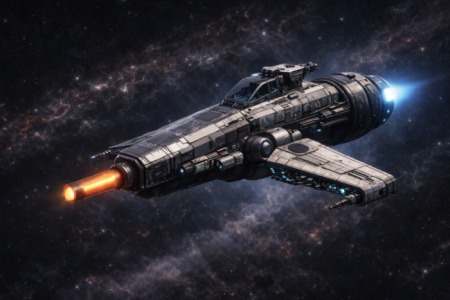 Aheiki (Wildcat) Fighter
.png)
The Aheiki-class Light Fighter, commonly known as the Wildcat, is a single-seat Alliance enforcement fighter designed as a fast, aggressive sublight gun platform rather than a miniature starship.
The Prosian word Aheiki literally translates to *“Wildcat”* in the Prosian language, a name reflecting the craft’s speed, aggression, and short-burst combat role.
Aheiki fighters were introduced as a refit complement to Karshina-class Star Frigates, providing rapid-response interception capability against fleeing pirate craft without expanding Alliance escalation doctrine.
Design Philosophy
The Aheiki-class is best described by pilots as a **“flying gun.”**
Rather than extended endurance or independent operation, the Wildcat is optimized around:
- Maximum weapon output
- Extreme acceleration
- Short, violent engagement windows
- Dependence on a host vessel for recovery and support
Most of the fighter’s mass and volume are dedicated to its engine nacelle and weapons systems, leaving minimal space for pilot comfort or redundancy.
Propulsion and Performance
The Aheiki-class does **not** carry a Phase Drive and is incapable of FTL travel.
Instead, it uses a high-energy repulsion-based nacelle that shares conceptual similarities with Phase Drive technology but lacks the ability to ingest interstellar material or generate a stable phase field.
Key characteristics include:
- Integrity field strength insufficient for FTL transit
- Repulsion-based acceleration only
- Faster than large vessels operating at sublight
- No ability to transition into Zarkine-scale travel
The engine’s repulsion field produces a **distinct blue glow**, visible even at low thrust, which serves as a clear visual indicator of active propulsion and field stability.
The fighter generates its greatest usable energy output while in motion, making high-speed attack passes central to its combat doctrine.
Endurance and Life Support
Operational endurance is intentionally limited.
- Flight time: approximately 2 hours
- Life support: approximately 3 hours
This design enforces strict mission discipline and prevents Wildcats from operating independently beyond controlled patrol envelopes.
Modular Wing System
The Aheiki-class employs a **modular wing doctrine** uncommon among light fighters.
Short Wings (Standard Configuration)
- Stubby, compact wings optimized for space combat and carrier operations
- Mounted on **lower fuselage pivot shafts**
- Capable of lowering and folding fully beneath the craft for dense hangar storage
- Can be fully detached using the same pivot mechanism for maintenance or replacement
Long Wings (Atmospheric Configuration)
- Installed when sustained atmospheric combat or patrol is expected
- Provide increased lift, stability, and reduced pilot workload
- Replace the short wings entirely rather than extending them
Both wing types incorporate **underside vector thrusters** designed to rapidly counter spins, stalls, and loss-of-control events, particularly during low-altitude atmospheric engagements.
Armament
The Aheiki-class is heavily armed for its size.
- Primary Weapon:
 * Alliance Mark II Regenerative Plasma Weapon
 * Forward-mounted
 * Optimized for precision strikes and disabling fire
 * Produces a characteristic **orangish glow**
 * When fully charged, visible **electrical arcs** crawl along the barrel
- Secondary Weapons:
 * Side and rear defensive plasma emitters
 * Intended for discouraging pursuit by enemy fighters
 * Limited power output, requiring multiple hits to be effective
The Wildcat is not designed for prolonged dogfights. Its weapons favor frontal attack runs and rapid disengagement.
Defensive Systems
Defensive systems are minimal and functional rather than robust.
- Light deflector shielding
- Minimal hull armor
- Reliance on speed and maneuvering for survival
The fighter’s integrity field is deliberately weak, sufficient only for structural cohesion under high acceleration and weapons discharge, but wholly inadequate for FTL stresses.
Cockpit and Pilot Module
The Aheiki cockpit is extremely cramped, prioritizing control access over ergonomics.
- Limited pilot movement
- Tight seating and control spacing
- Minimal environmental buffering
As a result, Aheiki pilots are typically shorter in stature. Among crews, the fighter has earned the informal nickname:
“Tall Man’s Misery.”
Ejectable Pilot Module
In catastrophic damage scenarios, the **entire pilot module can eject** from the craft.
- Includes full life-support systems
- Constructed primarily from advanced **carbon composites**
- Equipped with limited maneuvering thrusters
- Capable of basic orientation, collision avoidance, and short-range repositioning
Alliance doctrine places higher value on pilot survival than frame recovery.
Carrier Integration
Aheiki-class fighters are most commonly deployed aboard Karshina-class Star Frigates following the refit program.
Typical deployment includes:
- Four fighters per frigate
- Rapid-launch and recovery bays
- Centralized tactical control by the host vessel
Fold-under wings allow Wildcats to occupy minimal hangar volume when stowed.
Operational Use
Common mission profiles include:
- Intercepting fleeing pirate ships
- Delivering disabling fire to engines or control sections
- Forcing suspect vessels back toward inspection range
- Defensive screening during boarding operations
- Atmospheric interdiction using long-wing configuration
Wildcat pilots are trained to strike hard, disengage quickly, and return before endurance limits are reached.
Legacy
The Aheiki-class earned a reputation as a brutal but disciplined enforcement tool. Its presence dramatically reduced successful pirate escapes without increasing civilian casualties or provoking wider conflict.
Though uncomfortable and unforgiving to its pilots, the Wildcat remains respected as one of the most effective sublight interceptors ever fielded by the Alliance.